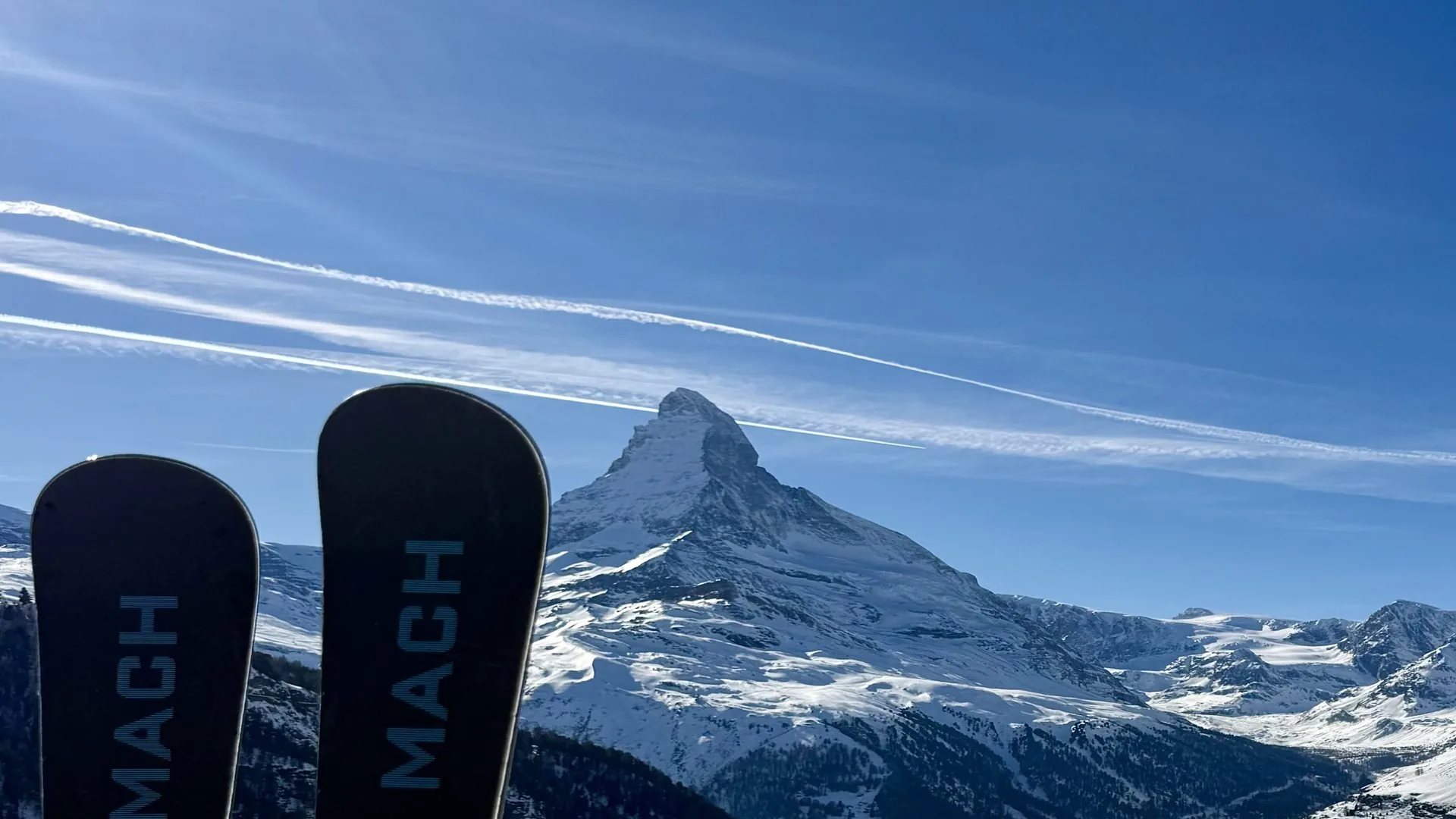
Every season I work with clients who arrive in Zermatt having either over-thought the kit situation or not thought about it at all. Some have booked the wrong lift pass, some have brought too much luggage, some didn't know they could hire a ski jacket in the village. This guide is what I'd tell you before you boarded the train.
Two things to cover: where and how to hire your equipment, and which lift pass actually makes sense for you. I'll keep it honest and practical — no unnecessary upselling, just what you need.
Replace this div with <img class="photo" src="your-photo.jpg" alt="...">
Hiring Skis in Zermatt
Zermatt has a good number of rental shops dotted around the village. The standard of equipment across the board is high — this is Switzerland, and the rental shops here are generally well run with current-season kit. That said, there's still a real difference between a shop where the staff genuinely know their stuff and one where you're just handed a pair of skis and pointed at the door.
My personal recommendation for clients has always been Mach Ski. They're the shop I send people to, and the feedback I get back is consistently good. More on them below.
My Pick: Mach Ski Zermatt
Mach Ski is my go-to recommendation for clients coming to Zermatt. The equipment is current season, well-maintained and properly fitted. The staff know the mountain and will ask the right questions — your ability level, the kind of skiing you want to do, the terrain you're planning to cover — and set you up with kit that actually suits you rather than just handing you the first pair that fits.
What I particularly like is that they do the whole package — skis, boots, poles, helmets, and crucially if you need it, ski jackets and ski pants as well. So if you're flying light or trying Zermatt for the first time before spending money on your own gear, you can walk in with nothing and walk out fully kitted from head to toe.
Book online before you arrive — it's cheaper, there's no queuing, and your kit will be ready when you get there.
What You Can Hire
Most shops in Zermatt — including Mach Ski — offer a full range of rental kit. Here's what's typically available:
- Skis, boots and poles — the standard package, available in beginner through to performance/freeride spec
- Helmets — always worth adding; a few francs a day and genuinely important on a busy mountain
- Ski jackets — rental ski jackets are ideal if you're travelling light or just don't want to invest in your own yet
- Ski pants / salopettes — same deal as the jacket; rent a pair rather than skiing in jeans
- Snowboards — most shops stock a full snowboard range alongside skis
- Children's equipment — kids' skis, boots and helmets are all available, and rental is a good option since children grow so fast
If you're coming for the first time and aren't sure whether skiing is for you long-term, hiring your clothes as well as your equipment is a genuinely smart move. A decent ski jacket costs CHF 300–600+ to buy. Renting for a week costs a fraction of that, and you don't have to travel with it. Same goes for pants. It's a proper option, not a compromise — the kit from good rental shops is good quality and warm.
Rental Prices — What to Expect
Zermatt rental shops use tiered pricing based on equipment quality. The rough categories are economy (solid, well-maintained kit from established brands), performance (newer, higher-spec skis suited to intermediate and above), and premium or race-spec (top-of-the-range, current season, for advanced skiers who want the best). Prices rise as you go up the tiers.
| Equipment | Approx. Price Per Day | Notes |
|---|---|---|
| Skis + boots + poles (economy) | CHF 35–50 | Good for beginners and leisurely skiers |
| Skis + boots + poles (performance) | CHF 50–70 | Better skis, more responsive — suits intermediates |
| Skis + boots + poles (premium) | CHF 70–90+ | Top-end current season kit for advanced skiers |
| Helmet | CHF 5–10 | Add to any package |
| Ski jacket (rental) | CHF 20–35 | Available at Mach Ski and select other shops |
| Ski pants (rental) | CHF 15–25 | Available at Mach Ski and select other shops |
All prices approximate for 2024–2025 season. Multi-day rentals work out cheaper per day than single-day rates. Book online for best prices.
Book online in advance: Almost every shop offers a discount for pre-booking online vs walking in. It can be 10–20% cheaper and means no queuing on your first morning.
Multi-day rates: A 6-day rental is significantly cheaper per day than renting daily. If you're staying a week, take the week package.
Collect the evening before: Most shops let you pick up your kit from 4pm the day before you ski. This means you start your first ski day fresh without standing in a shop at 8am.
Economy skis are fine for most people: Unless you're an advanced or expert skier, you genuinely won't notice the difference between economy and premium on most terrain. Save the money for your lift pass or a good lunch on the mountain.
Replace this div with <img class="photo" src="your-photo.jpg" alt="...">
Zermatt Lift Passes — Which One Do You Need?
This is the question I get asked constantly, and I understand why — the options can look confusing at first glance. Most people know about the Beginner Pass, the full Zermatt Pass and the International Pass. But there are several other options that barely get talked about — a half-day pass, a Sunnegga-only pass, single one-way rides up to the mountain restaurants, and even a point-to-point ticket to Cervinia for a lunch without skiing. All of it is worth knowing about.
Zermatt uses dynamic pricing — the pass costs more the closer you get to the date and on peak days. Buying through the Matterhorn Paradise website (matterhornparadise.ch) in advance is nearly always cheaper than buying at the ticket window. You also walk straight past the queues on your first morning, which is a genuinely good feeling.
The Beginner Pass is designed for complete beginners and those taking their very first ski lessons. It covers a limited but perfectly formed area around the bottom of Sunnegga — enough terrain to learn on without being overwhelming, and without paying for mountain access you're nowhere near ready to use.
The centrepiece for beginners is Wolli Park — the dedicated learning area named after Wolli the woolly mammoth, Zermatt's lovable resort mascot. It's flat, wide and safe, exactly the kind of terrain where you want to spend your first hour or two getting used to ski boots and figuring out how to stop. This is where I start all my beginner clients.
Once you've got the basics, the rest of the Beginner Pass area gives you access to the Sunnegga funicular and some gentle blue runs via the Eisfluh and Findeln chairlifts — enough to have a proper first or second ski day without feeling limited.
After a day or two at this level, most skiers are ready to step up to the full Zermatt Pass and access the whole mountain. The Beginner Pass is perfect for those first couple of days, or for anyone who genuinely wants to take their time learning.
- Sunnegga underground funicular (from the village up to Sunnegga)
- Wolli's Beginners Park (the dedicated learning area)
- Sunnegga–Blauherd combined lift
- Leisee Shuttle
- Eisfluh chairlift
- Findeln chairlift
- Gornergrat area
- Matterhorn Glacier Paradise / Klein Matterhorn
- Schwarzsee area
- Italy (Cervinia)
Children under 9 ski completely free in Zermatt with a Wolli Card. The card is free to collect from Zermatt Bergbahnen sales points or online. On top of the free lift access, the Wolli Card gives children free accommodation in many hotels and apartments, exemption from the visitor's tax, and invitations to Wolli events. Children aged 9–15 pay 50% of the adult pass price. On Saturdays, all children up to age 15 ski free.
The standard Zermatt Pass is what most people visiting for a ski holiday should buy. It covers the entire Swiss side of the Matterhorn Ski Paradise — all three main ski areas, around 200 kilometres of pistes across blue, red, black and yellow runs, and access all the way up to the Klein Matterhorn at 3,883m.
Three mountain areas for the price of one pass:
- Sunnegga–Rothorn — the sunniest slopes, south-facing, great blue and red runs, the area where beginners progress beyond the basics
- Gornergrat — the spectacular railway-accessed area with wide open runs and some of the best views on the mountain, including the famous panorama of 29 four-thousand-metre peaks
- Matterhorn Glacier Paradise (Klein Matterhorn) — the glacier skiing starting from 3,883m, year-round snow, longer and more demanding runs, and the gateway to Italy on the International pass
If you're an intermediate skier or above, or if you're here for more than two days, this is the pass you want. It covers more terrain than most people can ski in a week.
Prices vary depending on the date — Zermatt uses dynamic pricing, so peak weeks like Christmas and February half-term cost more. The rough adult day rate starts from around CHF 83–88 in quieter periods. A 6-day pass works out significantly cheaper per day.
- Full Sunnegga–Blauherd–Rothorn area
- Full Gornergrat area (including Findeln and Riffelalp zones)
- Full Matterhorn Glacier Paradise area (Klein Matterhorn, Schwarzsee, Trockener Steg)
- All lifts and gondolas on the Swiss side
- Free electric buses within Zermatt village
- Italian side — Cervinia and Valtournenche (International Pass only)
The International Pass covers everything in the Zermatt Pass, but adds the Italian side of the mountain — Breuil-Cervinia and Valtournenche. This is the pass that makes the legendary ski-from-Switzerland-into-Italy day possible. If you've read my blog about the Zermatt-to-Cervinia ski adventure, you'll know this is one of the genuinely great days you can have on skis anywhere in the world.
From the top of Klein Matterhorn, you can ski a near-continuous 11km descent down to Cervinia in Italy, dropping over 1,800 vertical metres. Then ski back up, have lunch on the Italian side, and return to Zermatt in the afternoon. You need the International Pass to do this legally — crossing the border on a Swiss-only pass is not permitted.
Is it worth the extra cost? For confident intermediates and above who are here for more than three or four days, and who are planning to cross into Italy at least once — yes, absolutely. It adds a cross-border adventure that you simply can't get anywhere else in the Alps. For beginners, families with young children, anyone on a short two or three-day trip, or skiers who just want to focus on the Swiss side — the standard Zermatt Pass is plenty.
The uplift in price over the standard Zermatt Pass is roughly CHF 15–20 per day for adults. It's a borderline decision for a four-day trip — borderline worth it. For a full week, if you're confident on the mountain, I'd take it.
- Breuil-Cervinia, Italy
- Valtournenche, Italy
- The full cross-border descent from Klein Matterhorn to Cervinia
A popular option that most people don't realise exists. If you're only skiing half a day — a late arrival, an early departure, a rest day that turns into a short session — you don't need to buy a full day pass. The half-day pass covers either a morning session (typically until noon) or an afternoon session (from noon), and saves you meaningful money against the full-day price.
It covers the full Zermatt ski area, not a limited zone. Particularly useful mid-week when you want a quick blast without committing to a full day on the mountain, or on your last day when you've got a train to catch. Buy it at the ticket office or online. A genuinely underused option.
This is a genuinely useful option that hardly anyone outside the local community knows about. If you want to get up to the Sunnegga area — not to ski, but to have lunch at Chez Vrony, Findlerhof or any of the other restaurants up in Findeln — you can buy a one-way ticket on the Sunnegga underground funicular for around CHF 10. No ski pass required. No ski hire required.
This is exactly how non-skiing partners, family members who are done for the day, or anyone visiting specifically for the mountain restaurants gets up there without paying for lift access they don't need. The Findeln hamlet and its restaurants are a short walk from the Sunnegga station. Once you're up, you can walk between the restaurants easily, take in the extraordinary Matterhorn views, and either walk back down to the village (a reasonable descent on the footpath) or take the funicular back down for another CHF 10.
One thing to know: the Sunnegga funicular is the access point. The chairlift from Sunnegga up towards the Findeln area restaurants is a separate lift — you can ride that one-way for around CHF 10 as well, even without skis, if you want to reach Chez Vrony or Findlerhof directly rather than walking from Sunnegga station. Worth asking at the ticket office.
- Non-skiers joining friends or family for mountain lunch
- Visiting Chez Vrony, Findlerhof or other Findeln restaurants
- A rest day from skiing with a proper mountain lunch
- Anyone who wants the Matterhorn view without a full day on the mountain
The same principle applies on the Klein Matterhorn side of the mountain. A one-way gondola ticket up to Furi costs around CHF 12 and gets you up to the mid-mountain area where some of Zermatt's finest mountain restaurants are located — Zum See, Gitz Gatti and the restaurants at Blatten are all accessible from here on foot.
Zum See in particular is one of the most celebrated mountain restaurants in Zermatt and worth the trip without skis. It has been run by the same family for over thirty years and the food is genuinely exceptional. Getting up to Furi for lunch, spending a long afternoon on the terrace, and walking or gondola-ing back down is a very good non-skiing day in Zermatt. No ski pass, no ski hire, just a one-way gondola ticket and a good appetite.
- Zum See — one of the great mountain restaurants in the Alps
- Gitz Gatti — traditional hut, worth seeking out
- Blatten — quiet, local atmosphere, excellent food
This is the one almost nobody knows about. You can buy a single point-to-point ticket on the Matterhorn Alpine Crossing cable car — from Zermatt all the way over to Cervinia in Italy, or the reverse — without skiing at all. This is the same cable car infrastructure that skiers use to cross the border, but operated as a scenic transport crossing for non-skiers and travellers.
The journey goes from Zermatt up through Trockener Steg to Klein Matterhorn (3,883m — the highest lift-served point in Europe) and then down into Cervinia. The views from the summit are extraordinary. In Cervinia you can have a proper Italian lunch, walk the village, and then either buy a return ticket or continue your journey into Italy by road.
This makes for an incredible non-skiing day out — an alpine crossing between two countries with lunch in Italy. It's not cheap, but it is a genuinely unique experience. Check the Matterhorn Paradise website for current pricing and operating hours, and always check weather and lift status before you go as the high-altitude connection closes in strong wind.
- The full Klein Matterhorn cable car experience to 3,883m — no skis required
- 360-degree views from the highest point in the Alps accessible by lift
- Lunch in Cervinia, Italy — proper Italian food at lower prices than Zermatt
- The border crossing experience without a ski pass
- Available as one-way or return — check matterhornparadise.ch for current prices
Which Pass Is Right for You?
Here's how I'd match the passes to the kind of skier you are — based on the conversations I have with clients at the start of every week:
| Type of Skier | Recommended Pass | Why |
|---|---|---|
| Complete beginner, day 1–2 | Beginner Pass | Wolli Park is where you start. No need to pay for terrain you can't reach yet. |
| Beginner progressing, day 3+ | Zermatt Pass | Opens up Gornergrat blues and more of Sunnegga. A huge step up in variety. |
| Intermediate, 4–7 days | Zermatt Pass | 200km is more than enough. Focus on skiing the Swiss side well first. |
| Confident intermediate / advanced, 5–7 days | International Pass | Do the Italy day. It's worth it. |
| Family with young children | Beginner or Zermatt Pass | Kids under 9 are free with a Wolli Card. Sunnegga is the best family area. |
| Short break (2–3 days) | Zermatt Pass | You'll be busy enough on the Swiss side. International is overkill for a short trip. |
| Only skiing half a day | Half-Day Pass | Full area access, half the price. Morning or afternoon session — no need to overpay. |
| Non-skier joining for mountain lunch (Sunnegga side) | Sunnegga one-way ~CHF 10 | Ride up to Chez Vrony or Findlerhof without a ski pass. Walk back or take the funicular down. |
| Non-skier joining for mountain lunch (Furi side) | Furi gondola one-way ~CHF 12 | Reach Zum See, Gitz Gatti or Blatten without skiing. One of the best lunches in the Alps. |
| Visiting Cervinia for lunch, no skiing | Matterhorn Alpine Crossing ticket | Cable car to 3,883m and down into Italy. Lunch on the Italian side, return or continue onward. |
Questions I Get Asked Every Season
Where is the best place to hire skis in Zermatt?
Can you hire ski clothes in Zermatt?
How much does ski rental cost in Zermatt?
What is Wolli Park and who is it for?
What's the difference between the Zermatt Pass and the International Pass?
Do children ski free in Zermatt?
Is it cheaper to buy lift passes online?
Got your kit sorted? Now sort your instructor.
Once you're kitted out and have your pass, get in touch. Private lessons, full-day guided adventures and the Zermatt-to-Cervinia ski day — this is what I do every season on this mountain.
Book a Lesson or Guide Day →WhatsApp me